
ID Series 6 Steam Oven
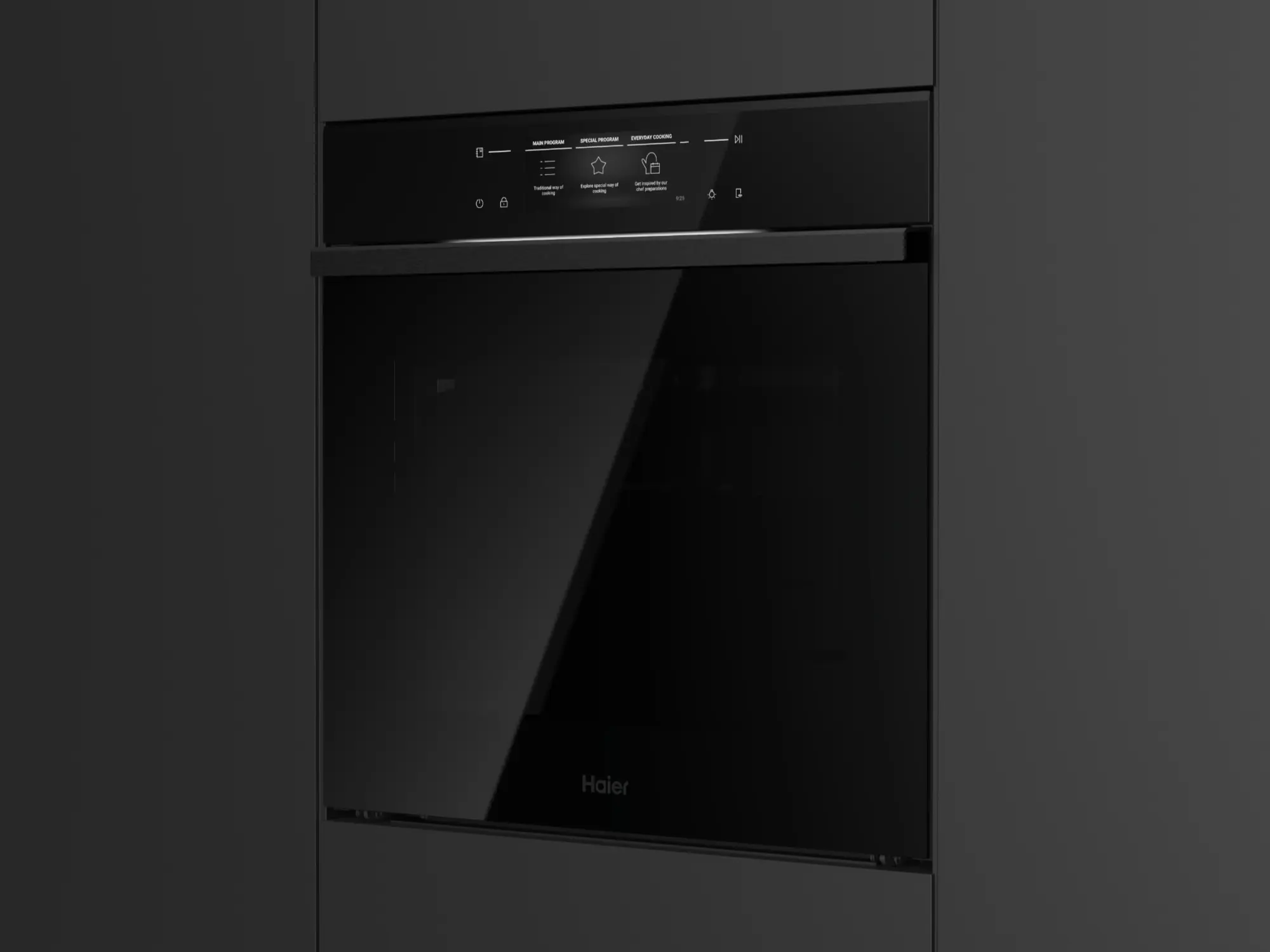
A steam cooking integration for Haier’s flagship premium oven, an award-winning premium oven with a large touchscreen. I extended the existing information architecture and design system to introduce new flows for manual cooking, special programs, and guided menus—including a new section dedicated exclusively to steam-only recipes.
Role
UX, UI, Interaction
Company
Haier Europe
Year
2024
Duration
4 months
Problem
The project started from Haier's ID Ultimate Oven Series 6, an award-winning→ premium oven→ with a large capacitive touchscreen. The goal was to integrate steam cooking capabilities while maintaining consistency with the existing information architecture and design system.
The challenge was to handle technical constraints like water tank presence, water level, preheating, and safety requirements in a way that felt clear and reassuring, without compromising the premium experience that had led to the product's awards.
Execution
I started with a competitor analysis focused on how other touchscreen ovens handled steam cooking and related constraints. One of the key findings was that only one other oven on the market was equipped with a water level sensor inside the steam cooking tank. This meant I had to rely on my own expertise to translate this technical information into a meaningful user experience. I designed alerts for low water levels, warning users that the remaining water might not be enough to complete the cooking cycle. I also added a pre-start alert (both for immediate and scheduled cooking) that notifies users if the tank is empty, preventing unpleasant surprises mid-cooking. These states were designed to be informative and actionable rather than simply blocking the user.
I worked closely with the engineering team to understand all the technical requirements for starting steam cooking, including tank detection, water level thresholds, preheating logic, and safety constraints. This collaboration was essential to ensure that every state I designed had a solid technical foundation and could be implemented reliably. At the same time, I coordinated with the marketing team to align on how new features and recipes should be positioned and communicated to users
Beyond the interface itself, I took the opportunity to update and consolidate the design system. The original Figma file had never been cleaned of unused elements during development, so I removed obsolete components, organized the library, and made extensive use of component properties. This made creating and maintaining screens significantly faster and more consistent for the entire team.
One of the more innovative aspects of this project was a side initiative I proposed: leveraging Haier's unique wireless and fully waterproof temperature probes. Unlike competitors—even well-known premium brands—whose temperature sensors are either wired or not waterproof, Haier's probes opened up the possibility of using them for sous vide cooking by sealing the probe inside the bag along with the food. With my manager's approval, I worked on this as a side project alongside an engineering team member, jointly defining the preparation process and designing the corresponding screen flows. This feature would have been a genuine differentiator in the market.
Solution
The final design integrated steam cooking into the existing menu architecture of the ID Ultimate Oven Series 6 without disrupting the established experience. New entry points were added for manual steam cooking with time and temperature settings, special programs with steam options, and guided menus—both for existing recipes updated with steam modes and for the new "Pure Flavour" section dedicated to steam-only recipes.
The interface included clear, state-driven flows that guided users through the entire process. Before starting cooking, the system automatically checked tank presence and water level, displaying specific messages when action was needed—such as refilling the tank or correctly inserting it. Preheating states were made visible with intermediate feedback, so users always knew what the oven was doing and why. Error conditions were handled with specific, actionable messages rather than generic warnings, and unavailable functions were locked with an explanation of the reason.
Visually, the new steam icons and the "Pure Flavour" section icon were fully aligned with Haier's Experience Design Language, creating a consistent thread across all menus and flows. The updated design system, cleaned and reorganized with component properties, ensured that all screens could be created and maintained more efficiently.
The sous vide probe feature, though developed as a side initiative, represented a unique value proposition: a cooking mode that competitors could not offer due to their hardware limitations. The flow defined the preparation steps and guided users through using the wireless probe inside the sealed bag, turning a technical advantage into a tangible user benefit.
Results
This project was cancelled during development, so there are no launch metrics or post-release data to report. However, the work delivered a comprehensive foundation for steam cooking integration that maintained the premium quality of the ID Ultimate Oven Series 6 while introducing meaningful new capabilities. The design system updates and component library cleanup also provided lasting value for the team, making future screen creation faster and more consistent.
Even though the project didn't reach production, it reinforced an important lesson: working on a mature, award-winning product isn't about "redoing" everything, but about integrating new complexity while preserving clarity and coherence. The sous vide probe initiative also showed how understanding unique hardware advantages can open up genuine differentiation opportunities that competitors simply cannot match.